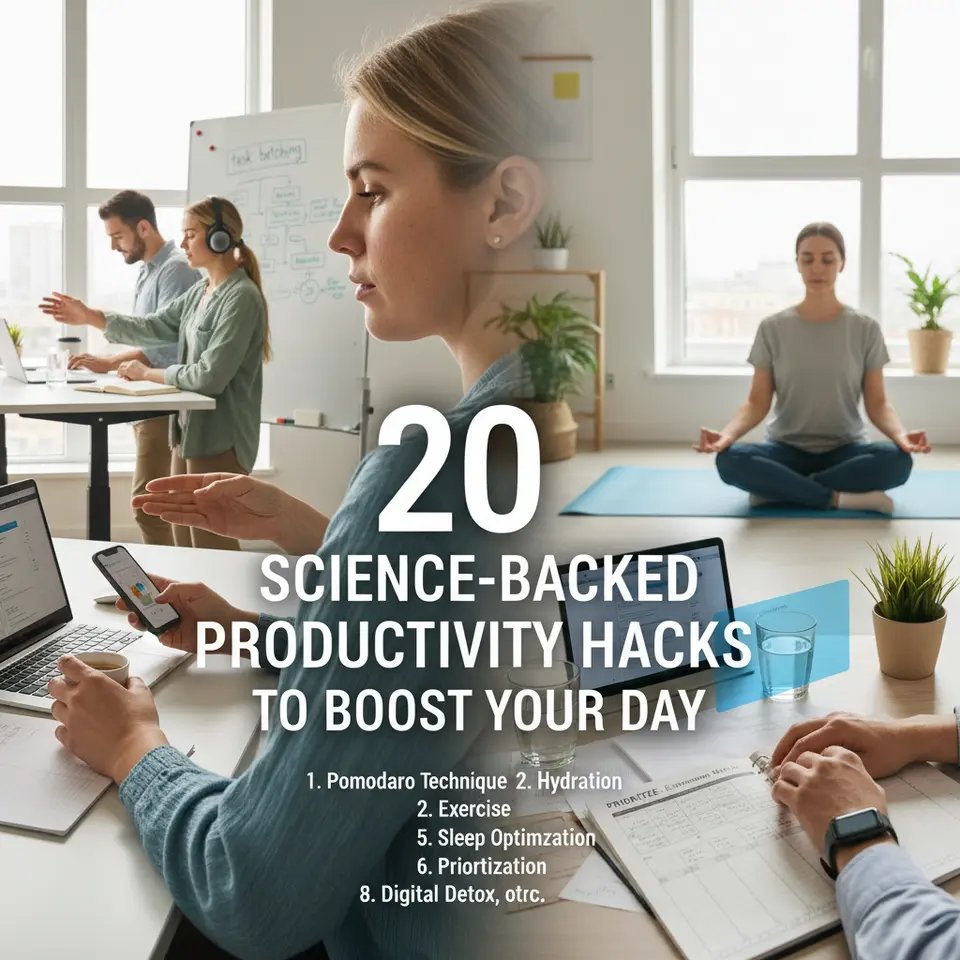
This guide explores science-backed productivity hacks, including time blocking, habit stacking, digital minimalism, and structured reflection to improve focus, reduce stress, boost efficiency, and create a sustainable work-life balance.
In today’s fast-paced professional environment, harnessing effective strategies to stay focused and efficient is more crucial than ever. Implementing science-backed productivity hacks empowers individuals to optimize their days by leveraging insights from cognitive psychology, behavioral science, and neuroscience. This year, professionals, students, and entrepreneurs are seeking reliable methods to reduce decision fatigue, overcome procrastination, and maximize their creative output. By integrating proven techniques such as time blocking, the Pomodoro Technique, and habit stacking, you can transform your workflow into a well-oiled machine tailored to your unique energy rhythms.
In this comprehensive guide, you will discover five major sections covering foundational time management, task prioritization, habit formation, workspace optimization, and reflection practices. Each section breaks down multiple actionable tips rooted in empirical research from authoritative sources like the American Psychological Association and the National Institutes of Health. Whether you’re working remotely, in an office, or balancing study with life commitments, these science-backed productivity hacks will help you streamline your routine, maintain momentum, and achieve sustainable success.
Read on to explore how you can reclaim control over your schedule, align your tasks with your natural energy peaks, and cultivate habits that drive consistent performance. By the end of this article, you’ll have a custom toolkit of productivity methods to implement today and refine throughout the year. Let’s dive into the first set of strategies focused on mastering your time.
Master Your Time with Structured Scheduling Techniques
Effective time management is the cornerstone of productivity. By partitioning your day into purposeful segments, you reduce the anxiety that comes with an overwhelming to-do list and minimize distractions. Below are several science-backed productivity hacks designed to help you structure your schedule for maximum focus.
Time Blocking for Deep Work
Time blocking involves dedicating specific intervals to single tasks or activities. Research indicates that this approach curbs decision fatigue and enhances concentration by creating clear boundaries for work phases. To begin, list all your tasks for the day and estimate how long each will take. Next, group similar tasks and assign dedicated blocks in your calendar. Incorporate buffer periods for interruptions and brief rest breaks. This strategy not only ensures high-priority items receive adequate attention but also provides a visible roadmap for your day, empowering you to track progress effectively.
Implement the Pomodoro Technique
The Pomodoro Technique, devised by Francesco Cirillo, segments work into 25-minute focus intervals followed by five-minute breaks. Cognitive studies show attention tends to wane after 20 minutes, making these short pauses crucial for mental rejuvenation. Use a timer or Pomodoro app to log sessions, and after four cycles, reward yourself with a longer break of 15 to 30 minutes. Over time, you’ll become adept at predicting how many sessions each task requires, refining your planning skills, and dramatically boosting sustained productivity.
The Two-Minute Rule for Quick Wins
Described in David Allen’s methodology, the two-minute rule states that if a task can be completed in two minutes or less, tackle it immediately. This leverages the Zeigarnik effect—our discomfort with unfinished tasks—to prevent small actions from accumulating. Replying to emails, sorting documents, or clearing your desk are perfect candidates. Completing these tasks instantly creates momentum and keeps your task list clear, allowing you to devote uninterrupted focus to more complex projects.
Batching Similar Tasks
Switching contexts between unrelated activities drains cognitive resources and hampers efficiency. Instead, batch tasks with similar requirements—such as responding to messages, conducting phone calls, or drafting reports—into separate blocks. Occupational psychology research suggests that task batching can increase productivity by up to 40 percent. Schedule your most demanding batches during your peak energy windows and handle routine tasks in lower-energy periods to maintain consistent output throughout the day.
Prioritize with Purpose to Maximize Impact

Prioritization ensures you invest your best efforts in tasks that yield the greatest returns. By filtering out busywork and focusing on high-leverage activities, you can prevent burnout and maintain a strategic outlook. The following science-backed productivity hacks will help you discern what truly matters and execute it effectively.
Use the Eisenhower Matrix
The Eisenhower Matrix categorizes tasks into urgent/important, important/not urgent, urgent/not important, and neither urgent nor important. This framework enables clear decision-making: tackle critical tasks first, schedule essential but non-urgent projects, delegate tasks that don’t require your expertise, and eliminate trivial activities. By visualizing your workload using this matrix, you can reduce stress and ensure that your efforts align with long-term objectives.
Set SMART Goals
SMART goals—Specific, Measurable, Achievable, Relevant, Time-bound—provide a structured roadmap for progress. Rather than vague intentions like “improve writing,” aim for “draft 1,000 words for the report by Friday at 5 pm.” This clarity enhances motivation and accountability. Break down larger ambitions into SMART sub-goals for incremental achievements and routinely review them to stay aligned with evolving priorities.
Leverage Digital Minimalism
Digital clutter fragments your attention and increases stress. Cal Newport’s philosophy of digital minimalism encourages auditing apps and notifications, keeping only those that deliver significant value. Turn off non-essential alerts, organize your desktop, and employ website blockers during focus sessions. Neuroscience research shows that reducing digital distractions fosters deeper concentration and better decision-making. Simplifying your digital environment creates mental space for high-impact tasks.
Embrace Single-Tasking
Contrary to popular belief, multitasking reduces accuracy and slows progress. Single-tasking—devoting uninterrupted attention to one task at a time—leads to higher-quality work and faster completion. To implement this, disable notifications, close irrelevant tabs, and establish clear objectives for each session. Over time, you’ll find that sustained, focused engagement yields more satisfying results than splitting your attention across multiple activities.
Build High-Impact Habits for Consistent Performance
Habits shape daily behaviors and, when aligned with productivity goals, create lasting performance gains. By stacking new habits onto existing routines and honoring your biological rhythms, you can automate desirable behaviors and maintain momentum with minimal effort.
Habit Stacking
Popularized by James Clear, habit stacking links a new micro-habit to an established routine, leveraging associative triggers in the brain. For instance, after brewing your morning coffee, spend three minutes reviewing your top three priorities. This small addition benefits from the cue of the existing routine, making it easier to adopt without willpower alone. Gradually build on these habits as they become automated, compounding productivity gains over time.
Align with Peak Energy Periods
Your circadian rhythm dictates natural peaks and troughs in alertness. Track your focus levels over a week to identify when you’re most creative and attentive. Schedule challenging tasks like writing or problem-solving during these prime windows, and reserve routine work for lulls. Chronopsychology studies confirm that respecting these rhythms reduces errors, boosts efficiency, and enhances overall well-being by preventing cognitive overload.
Adopt a Powerful Morning Routine
Your morning rituals set the tone for the day. Incorporate hydration, light exercise, and a brief planning session to stabilize your circadian rhythm and build early momentum. Mindfulness practices or journaling can cultivate a positive mindset, while a healthy breakfast fuels both body and brain. Automate these steps to avoid decision fatigue and ensure you begin each day with clarity and purpose.
Practice Mindfulness and Meditation
Even brief mindfulness sessions of five to ten minutes can yield significant benefits in focus and stress reduction. Techniques like focused breathing or body scans enhance your ability to observe distracting thoughts without judgment, strengthening your capacity to return to the task at hand. Incorporate these micro-sessions between work intervals to refresh mental resources and sustain high levels of concentration.
Optimize Environment and Tools for Maximum Efficiency

Your workspace and digital toolkit can either support or hinder productivity. By designing an ergonomic environment and leveraging automation, you reduce friction and free up mental bandwidth for core work activities.
Enhance Ergonomics
An ergonomically optimized workspace prevents discomfort and repetitive strain injuries that sap focus. Position your monitor at eye level, ensure your chair supports proper posture, and keep your wrists neutral while typing. Add elements such as natural light, indoor plants, and minimal clutter to boost mood and cognitive performance. A physically comfortable environment promotes sustained attention and healthier work sessions.
Automate Repetitive Tasks
Automation tools like Zapier, IFTTT, and built-in email filters can handle repetitive, rule-based tasks—such as data entry, file organization, or report distribution—without manual intervention. Map out routine workflows, identify triggers, and set up integrations to execute processes automatically. This not only saves time but also reduces the risk of human error, allowing you to focus on creative and strategic tasks that require your expertise.
Master Keyboard Shortcuts
Whether you’re drafting documents, managing spreadsheets, or navigating your operating system, keyboard shortcuts dramatically speed up repetitive actions. Dedicate time to learning the most common hotkeys for your primary applications, and practice them daily until they become instinctual. Over weeks, these small efficiencies accumulate into hours of reclaimed time and smoother workflows.
Embrace Digital Organization
Maintain a systematic folder structure for your files, use descriptive naming conventions, and archive completed projects. Implement a version control process for critical documents and utilize cloud storage solutions for automatic backups. A well-organized digital environment reduces time wasted searching for assets and ensures you can retrieve important information instantly.
Reflect, Review, and Refine for Continuous Growth

Ongoing reflection and weekly reviews are critical for maintaining alignment with long-term objectives and adapting your system as needs evolve. Structured reflection helps you learn from successes and setbacks, ensuring continuous improvement.
Weekly Reviews
Dedicate 30 to 60 minutes at the end of each week to evaluate your accomplishments, challenges, and upcoming priorities. Capture new tasks, clarify next actions, and organize projects following principles from the Getting Things Done methodology. This practice enhances self-awareness and prevents important tasks from slipping through the cracks.
Conduct Regular Self-Assessments
Periodically measure your progress toward SMART goals and adjust timelines as needed. Use metrics such as completed Pomodoro sessions, habit streaks, or goal milestones to quantify achievements. Reviewing these indicators regularly provides motivational feedback and helps you stay accountable.
Seek External Feedback
Engage mentors, colleagues, or accountability partners to gain new perspectives on your workflow. External feedback can highlight blind spots, suggest fresh ideas, and reinforce your commitment to improvement. Structured check-ins every few weeks ensure you’re on track and adapting best practices in today’s digital landscape.
Iterate and Optimize
No system is perfect from the start. Experiment with different time intervals, task sequences, or tools to find the combination that resonates with your working style. Document what works and what doesn’t, and be willing to refine your approach based on data and self-reflection. Continuous iteration transforms a static schedule into a dynamic productivity engine.
Conclusion
Implementing these science-backed productivity hacks can revolutionize the way you approach work and life. By mastering structured scheduling, purpose-driven prioritization, habit-based routines, optimized environments, and reflective reviews, you create a personalized framework that aligns with your unique energy patterns and professional goals. Remember that consistency and gradual implementation are key—start with one or two strategies today and expand your toolkit as you experience tangible improvements.
In today’s busy year, adopting these methods equips you to handle complex projects, reduce stress, and maintain a healthy work-life balance. As you refine this system through weekly reviews and continuous feedback, you’ll unlock higher levels of focus, creativity, and sustained performance. Embrace these science-backed productivity hacks now and watch your daily efficiency soar.
FAQs
1. What are science-backed productivity hacks?
Science-backed productivity hacks are strategies based on research in psychology, neuroscience, and behavioral science that help improve focus, efficiency, and performance in daily tasks.
2. Why is time blocking effective for productivity?
Time blocking is effective because it reduces decision fatigue, minimizes distractions, and creates structured periods for focused, high-priority work.
3. How does the Pomodoro Technique improve focus?
The Pomodoro Technique improves focus by breaking work into short intervals with breaks, helping the brain maintain attention and avoid burnout.
4. What is habit stacking in productivity?
Habit stacking is a method where a new habit is attached to an existing routine, making it easier to build and maintain consistent behaviors.
5. How can I reduce procrastination effectively?
You can reduce procrastination by using techniques like the Two-Minute Rule, breaking tasks into smaller steps, and starting with high-priority work first.
6. What is digital minimalism in productivity?
Digital minimalism is the practice of reducing unnecessary digital distractions, limiting apps and notifications, and focusing only on essential tools.
7. How do energy levels affect productivity?
Energy levels affect productivity by determining when you are most focused and creative, helping you schedule difficult tasks during peak performance hours.
8. Why is single-tasking better than multitasking?
Single-tasking is better because it improves accuracy, reduces cognitive load, and allows deeper focus on one task at a time.
9. How often should I review my productivity system?
You should review your productivity system weekly for adjustments and monthly for greater improvements and long-term optimization.
10. Can productivity hacks reduce stress?
Yes, productivity hacks reduce stress by organizing tasks, improving time management, and creating a clear structure for daily work.