
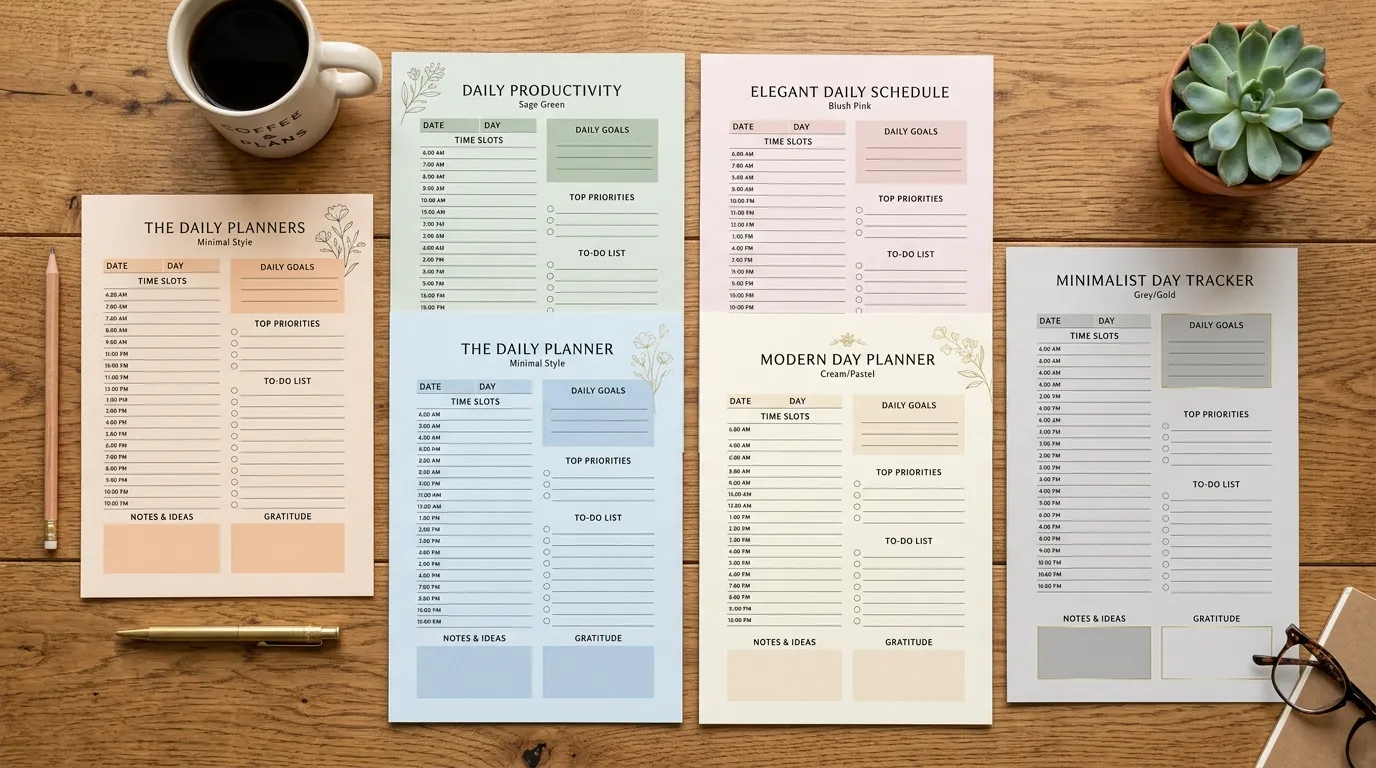
This guide breaks down exact methods for organizing tasks efficiently. You will discover time-blocking frameworks, printable versus digital comparisons, expert productivity insights, and top tools. Master your daily routine, eliminate decision fatigue, and regain control over your precious time today.
Best Daily Schedule Templates help individuals organize tasks, manage time efficiently, and improve productivity throughout the day. Whether you are a student, professional, entrepreneur, or remote worker, using a structured daily schedule template can reduce stress and increase focus. Popular templates include hourly planners, time-blocking schedules, to-do list layouts, and printable productivity trackers. Digital tools and apps also offer customizable scheduling options for better task management. Learning how to use these templates effectively involves prioritizing important activities, setting realistic goals, scheduling breaks, and tracking progress consistently. A well-designed daily schedule improves work-life balance, enhances concentration, and helps build positive habits. By choosing the Best Daily Schedule Templates for your lifestyle and workflow, you can stay organized, meet deadlines, and maximize productivity while maintaining flexibility in your daily routine.
Why You Need the Best Daily Schedule Templates & How to Use Them
When you wake up without a plan, you immediately surrender your day to external demands. A structured routine acts as a defensive shield against distractions. Implementing the Best Daily Schedule Templates & How to Use Them allows you to prioritize high-impact tasks, protect your energy, and establish a healthy work-life balance.
Research continually proves that relying on memory alone leads to dropped tasks and heightened stress. According to insights from McKinsey & Company, professionals who utilize structured project management tools and daily planners increase their project completion rates drastically. Writing your goals down offloads the mental burden of remembering them, effectively curing decision fatigue.
The Core Productivity Benefits
- Enhanced Focus: Allocating specific time blocks to specific tasks prevents multitasking, which research shows reduces efficiency.
- Clear Task Prioritization: A schedule forces you to identify what truly matters versus what merely feels urgent.
- Stress Reduction: Knowing exactly what to do and when to do it eliminates the anxiety of the unknown.
- Improved Consistency: Using daily templates builds muscle memory for success, paving the way for long-term goal achievement.
To get the most out of your workflow, you must understand how to effectively integrate these templates alongside weekly schedule templates to capture both micro and macro goals.
Digital vs. Printable Templates: A Structured Comparison
Before diving into advanced strategies, you must choose a medium that fits your lifestyle. Finding the Best Daily Schedule Templates & How to Use Them depends heavily on whether you prefer the tactile feel of paper or the dynamic flexibility of software.
|
Feature |
Digital Schedule Templates (e.g., Notion, Google Calendar) |
Printable Schedule Templates (e.g., PDFs, Planners) |
|---|---|---|
|
Accessibility |
Available across all devices; syncs automatically. |
Requires physical carrying; easily visible on a desk. |
|
Flexibility |
Drag-and-drop editing; easy to adjust shifting deadlines. |
Requires erasing or crossing out; less forgiving for changes. |
|
Automation |
Recurring tasks, alarms, and integrated reminders. |
Fully manual; relies on personal discipline to check. |
|
Distraction Level |
High risk of digital notifications and tab-switching. |
Zero digital distractions; promotes deep focus. |
|
Collaboration |
Easily shared with teams via links and permissions. |
Strictly personal; difficult to share real-time updates. |
For maximum efficiency, many professionals use a hybrid approach. They use a digital calendar for meetings and collaborative events, while keeping a printable daily planner on their desk for personal task prioritization and focused deep work.
E-E-A-T-Based Strategies: Structuring Your Day for Success
Understanding the Best Daily Schedule Templates & How to Use Them goes beyond simply downloading a file. You must apply proven, authoritative strategies to your planning process.
Master Time Blocking
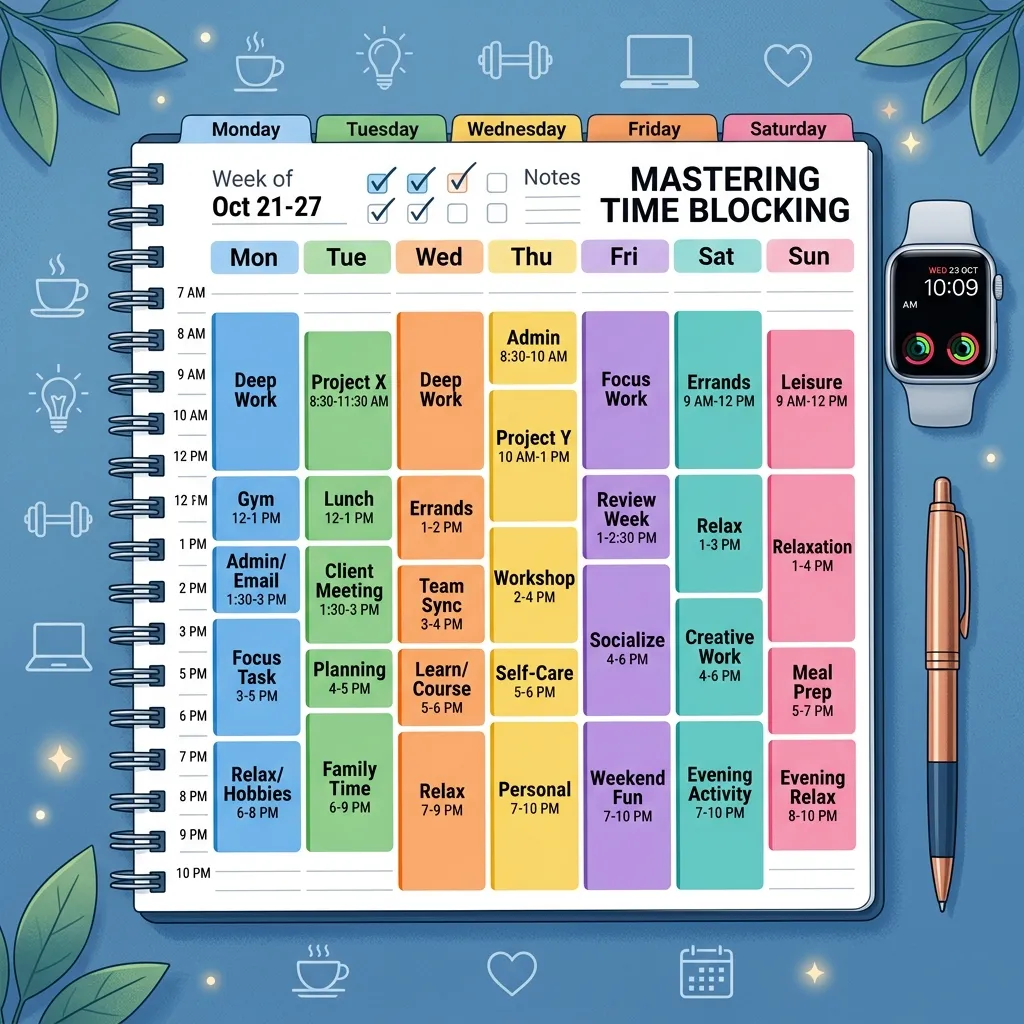
Time blocking involves dividing your day into distinct, dedicated blocks of time, each assigned to a specific task or category of work. Instead of working from a standard to-do list, you assign a start and end time to every task.
- Deep Work Blocks: Schedule your most complex tasks during your peak energy hours. For most people, this is early in the morning.
- Admin Blocks: Group low-energy tasks like answering emails, organizing files, and updating habit tracking logs into a single afternoon block.
- Buffer Blocks: Always leave 15-to-30-minute gaps between heavy tasks. Meetings run over, and unexpected urgent matters arise.
Leverage Habit Stacking

Habit stacking involves pairing a new habit you want to build with a current habit you already perform daily. When filling out your daily planner, link your schedule creation to an existing morning routine. For instance, “While I drink my morning coffee, I will spend five minutes filling out my daily schedule template.” This creates an effortless trigger for your productivity planner.
Align with Your Energy Levels

A common scheduling trap involves ignoring your natural circadian rhythms. If you experience a slump at 2:00 PM, do not schedule a highly demanding creative task for that time. The Best Daily Schedule Templates & How to Use Them accommodate your biological clock. Track your energy for a week to discover your peak performance windows, then build your template around that data.
Common Mistakes to Avoid
Even with the Best Daily Schedule Templates & How to Use Them, people frequently fall into scheduling traps that ruin their productivity. Avoid these critical errors:
1. Overestimating Your Capacity
The human brain naturally underestimates how long tasks take—a phenomenon known as the planning fallacy. Always multiply your estimated task time by 1.5. If you think writing a report will take one hour, block out an hour and a half.
2. Ignoring Breaks and Resets
A schedule packed end-to-end without breaks guarantees burnout. Studies highlighted by the Harvard Business Review reveal that taking short, frequent breaks significantly improves sustained concentration. Use frameworks like the Pomodoro Technique (25 minutes of work, 5 minutes of rest) within your time blocks.
3. Being Too Rigid
Life happens. Urgent calls come in, software crashes, and priorities shift. If your schedule shatters at the first sign of disruption, it is too rigid. Treat your daily schedule as a flexible roadmap, not an unbreakable contract.
Expert Insights on Daily Planning
Top executives and productivity experts approach their days with relentless intentionality. When assessing the Best Daily Schedule Templates & How to Use Them, industry leaders focus heavily on simplification.
“The most successful people do not have longer days; they have better boundaries. A daily schedule is your primary tool for boundary management.”
Experts agree that a successful schedule does not look entirely full. According to technology research firm Gartner, optimizing workflow efficiency actually requires building intentional slack into the system to handle operational variability.
The “Top 3” Rule
Productivity experts swear by the “Top 3” framework. Before looking at your massive backlog of tasks, identify the three non-negotiable tasks that must get done today. Highlight these in your template. If you only accomplish these three tasks, you can still consider the day a success.
How to Implement Your Template Effectively
Ready to take action? Here is a step-by-step workflow for integrating the Best Daily Schedule Templates & How to Use Them into your life.
Step 1: The Brain Dump
Get every lingering thought, task, and obligation out of your head and onto a piece of scratch paper. Do not organize them yet. Just write them down.
Step 2: Categorize and Prioritize
Review your brain dump. Delete tasks that offer no value. Delegate tasks someone else can handle. Highlight the urgent and important tasks that require your immediate attention.
Step 3: Block Your Time
Transfer your prioritized tasks into your daily schedule template. Assign realistic time frames to each. Remember to include your lunch break, commuting time, and small buffers.
Step 4: Execute and Adjust
Follow the plan as closely as possible. At the end of the day, review your template. Did you allocate enough time for your tasks? What distracted you? Use this data to adjust your template for tomorrow.
Integrating these practices ensures that your schedule serves you, rather than you serving your schedule.
Conclusion
Mastering the Best Daily Schedule Templates & How to Use Them completely revolutionizes how you work, live, and achieve your goals. By combining structured time blocks, prioritizing daily tasks, and avoiding common over-scheduling traps, you claim absolute ownership of your day. Ready to skyrocket your productivity? Download a daily schedule template today and start mapping out your success!
FAQs
1. What makes the Best Daily Schedule Templates & How to Use Them effective?
The best templates provide a clear visual layout of your day, combining hourly time blocking with prioritized task lists. They work effectively because they remove the guesswork from your day, allowing you to focus entirely on execution rather than planning.
2. Should I use a digital or printable daily schedule?
It depends entirely on your working style. Digital schedules offer automated reminders and easy adjustments, making them great for dynamic work environments. Printable schedules eliminate digital distractions and provide a satisfying tactile experience for deep-focus workers.
3. How do I stick to my daily schedule?
Start small. Do not schedule every single minute of your day initially. Build in massive buffer times and focus only on completing your top three priority tasks. Consistency builds over time through realistic, manageable planning.
4. What is time blocking and how does it relate to scheduling?
Time blocking is a productivity method where you divide your day into specific segments dedicated to distinct tasks. Your daily template serves as the visual canvas where you draw out these dedicated blocks of time.
5. How much buffer time should I include in my daily template?
Experts recommend adding a 15-to-30-minute buffer between major tasks or meetings. This accounts for bathroom breaks, urgent micro-tasks, and the inevitable mental fatigue of switching contexts between projects.
6. Can a daily schedule improve my work-life balance?
Absolutely. A daily schedule clearly dictates when your workday ends. By seeing a visual “stop” time, you can effectively disconnect from work and dedicate your remaining hours to personal hobbies, family, and relaxation.
7. How do I handle unexpected urgent tasks that ruin my schedule?
Leave at least one hour of “flex time” completely blank in your daily template. When an emergency arises, deal with it, and shift your displaced tasks into that dedicated flex block later in the day.
8. When is the best time to fill out my daily schedule template?
The most effective time is the night before. Planning your tomorrow at the end of today allows you to wake up with a clear mind and immediately start executing tasks, rather than wasting peak morning energy on decision-making.
9. What should I do if I consistently fail to finish my scheduled tasks?
You are likely experiencing the planning fallacy. Start doubling the amount of time you estimate for complex tasks, and significantly reduce the total number of items on your daily list.
10. Do I need to schedule my weekends using these templates?
Not necessarily. While some highly structured individuals enjoy weekend scheduling, most people benefit from leaving weekends largely unstructured to promote mental recovery and spontaneous relaxation.