

This guide explores the foundational concepts of organizing your schedule, answering the core question: what is time management and why is it important? By the end of this article, you will have a step-by-step blueprint to maximize your output while protecting your energy and well-being.
Every day seems filled with interruptions, shifting priorities, and distractions, making it easy to lose sight of what truly matters. You may find yourself busy but never productive, stressed by endless to-do lists and constantly reacting instead of planning. Effective time management changes that dynamic. By learning to organize your hours, prioritize the right tasks, and protect your focus, you gain the confidence and clarity to achieve goals that once felt out of reach. In this guide, you’ll learn practical, proven strategies to transform your days and finally take control of your time and results.
Understanding the mechanics of controlling your daily hours empowers you to reclaim your focus, obliterate stress, and achieve your biggest ambitions faster than ever before. In this comprehensive guide, we will break down the exact strategies you need to take control of your day.
What Is Time Management and Why Is It Important?
At its most basic level, time management involves the conscious process of planning, organizing, and dividing your available hours between specific activities. It requires you to work smarter, not necessarily harder, so you can get more done in less time. This skill becomes especially vital when time is tight and pressures are high.
Failing to manage your schedule damages your effectiveness and causes immense stress. Conversely, exceptional organizational skills allow you to navigate heavy workloads with ease. When we ask what is time management and why is it important, we must look at the direct correlation between structured days and peak performance. Professionals who leverage effective productivity tools consistently outperform their peers because they prioritize high-leverage tasks over low-value busywork.
By taking ownership of your calendar, you stop letting external demands dictate your day. Instead, you design a proactive routine that ensures you dedicate your best energy to your most critical objectives.
The Core Components of Effective Time Management

To build a reliable system, you must understand the essential building blocks of productivity. Great time management does not mean packing every minute of your day with relentless work. Instead, it revolves around strategic alignment.
Planning and Goal Setting
You cannot manage your time effectively if you do not know where you are going. Setting clear, actionable goals gives your schedule purpose. When you define what you want to achieve, you can reverse-engineer the steps required to get there. Utilizing proven goal-setting strategies, such as the SMART criteria (Specific, Measurable, Achievable, Relevant, Time-bound), ensures your daily actions push you toward tangible results.
Ruthless Prioritization
Not all tasks carry the same weight. Prioritization requires you to identify the few vital activities that drive the most significant results. Effective professionals evaluate their to-do lists daily, separating urgent matters from truly important initiatives. This prevents you from wasting peak energy on trivial administrative duties.
Strategic Delegation
High achievers understand they cannot do everything themselves. Delegation involves assigning tasks to others who can complete them more efficiently or at a lower opportunity cost. Whether you delegate to a team member, hire a freelancer, or use automation software, removing low-value items from your plate frees you up to focus on deep, impactful work.
7 Proven Benefits: Why Managing Your Schedule Matters

Understanding the mechanics is only half the battle. To truly commit to a better system, you need to understand the profound benefits it brings to your career and personal life.
1. Skyrockets Your Productivity
When you allocate specific blocks of time to specific tasks, you eliminate the friction of deciding what to do next. You dive straight into the work. This focused approach minimizes context switching, allowing you to produce higher-quality work at a much faster pace.
2. Slashes Stress and Anxiety
Feeling overwhelmed usually stems from a lack of control. When tasks pile up and deadlines loom, your brain panics. A structured schedule acts as an antidote to this anxiety. By mapping out exactly when and how you will complete your responsibilities, you regain a sense of control. For those dealing with high pressure, mastering this skill remains a cornerstone of workplace stress management.
3. Enhances Decision-Making Abilities
Fatigue ruins your ability to make good choices. When you constantly rush from one emergency to another, you make snap decisions based on panic rather than logic. Proper planning gives you the breathing room to evaluate options carefully, gather necessary data, and make strategic choices that benefit your long-term vision.
4. Builds a Healthier Work-Life Balance
Work will expand to fill the time you allow it. If you do not set firm boundaries, your professional responsibilities will bleed into your evenings and weekends. By managing your hours efficiently during the workday, you can confidently log off at 5 PM. This allows you to recharge, spend time with loved ones, and pursue personal hobbies without feeling guilty.
5. Boosts Your Professional Reputation
Dependability builds trust. When you consistently deliver projects on time and arrive fully prepared for meetings, your colleagues and superiors take notice. Excellent organizational skills signal to management that you possess the discipline and reliability required for leadership roles.
6. Reduces Wasted Friction
Every time you lose focus, it takes an average of 23 minutes to regain deep concentration. A structured day removes the distractions that cause this friction. By silencing notifications and establishing boundaries, you protect your attention and preserve your mental stamina.
7. Creates Momentum and Confidence
Ticking a challenging item off your to-do list releases dopamine. When you structure your day to ensure early, consistent wins, you build unstoppable momentum. This psychological boost increases your confidence and motivates you to tackle even larger challenges.
Step-by-Step Guide: How to Build a Bulletproof Time Management System

Ready to transform your daily routine? Follow these practical, actionable steps to build a personalized system that guarantees results.
Step 1: Conduct a Brutally Honest Time Audit
Before you can optimize your schedule, you must understand how you currently spend your hours. For three consecutive days, track everything you do in 30-minute increments. Be brutally honest. If you spent 45 minutes scrolling through social media, write it down.
At the end of the three days, categorize your activities into:
- Deep work (high value)
- Shallow work (administrative, low value)
- Wasted time (distractions)
This audit will reveal massive inefficiencies and highlight exactly where you need to implement boundaries.
Step 2: Choose Your Methodology
No single framework works for everyone. You must select a methodology that aligns with your natural working style. Experiment with the frameworks detailed in the comparison table below until you find the perfect fit.
Step 3: Block Your Calendar
Once you know your goals and have a framework, start time blocking. Treat appointments with yourself with the same respect you would give a meeting with your CEO. Schedule blocks for deep work, email processing, and even breaks.
Step 4: Automate and Eliminate
Review your task list and identify anything you can automate or eliminate entirely. Use software to schedule social media posts, set up email filters to sort incoming messages, and decline meetings that do not require your active participation.
Top Time Management Frameworks: A Comparison
To help you choose the best system for your workflow, review this breakdown of the most effective frameworks used by top performers.
Pro Tips and Expert Insights for Peak Performance
Even with a solid framework, you can always optimize your routine further. Keep these expert insights in mind as you refine your daily habits.
- Eat the Frog First: Tackle your hardest, most anxiety-inducing task first thing in the morning. Completing this major hurdle creates a massive sense of relief and sets a positive tone for the rest of the day.
- Batch Similar Tasks: Group repetitive tasks together. For example, instead of checking your inbox 20 times a day, schedule two 30-minute blocks specifically for email. This reduces the cognitive load of switching contexts.
- Leverage Your Ultradian Rhythms: Human brains operate in cycles of approximately 90 minutes of peak focus followed by 20 minutes of fatigue. Structure your deep work blocks to match these natural biological rhythms to maximize your output.
- Plan Tomorrow Tonight: Never wake up wondering what you need to do. Spend the last 10 minutes of your workday writing out your top three priorities for the following morning.
According to research from the American Psychological Association, establishing a structured routine drastically improves emotional resilience and cognitive performance, proving that these simple habits yield massive long-term dividends.
Common Mistakes to Avoid When Managing Your Schedule
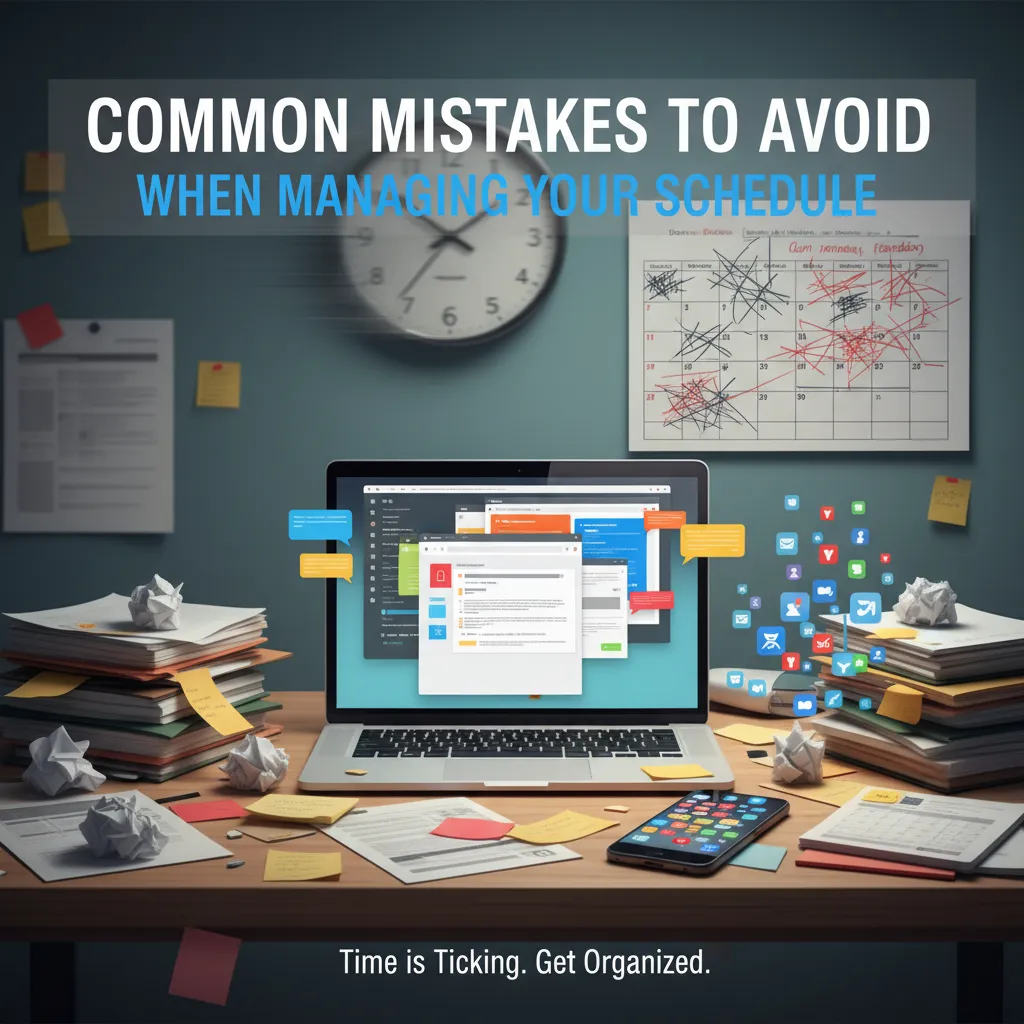
Many professionals try to optimize their days but fall into subtle traps that sabotage their progress. Avoid these common pitfalls to keep your system running smoothly.
The Multitasking Myth
Attempting to do two complex things at once destroys your efficiency. The human brain cannot focus on two distinct cognitive tasks simultaneously; it merely switches rapidly between them. This switching drains your energy and drastically increases your error rate. Focus on single-tasking instead.
Underestimating Task Duration
We consistently suffer from the planning fallacy—the tendency to underestimate how long a project will take. To counter this, always add a 25% buffer to your time estimates. If you think a report will take two hours, block off two and a half hours. This buffer absorbs unexpected interruptions and prevents your entire day from derailing.
Forgetting to Schedule Rest
Treating yourself like a machine guarantees burnout. Skipping breaks does not make you more productive; it merely guarantees that your afternoon work will be sluggish and prone to mistakes. You must proactively schedule short walks, lunch breaks, and moments away from the screen to sustain high performance over the long haul.
Chasing Inbox Zero All Day
Your inbox is a list of other people’s priorities. If you keep your email open all day, you allow external demands to hijack your schedule. Turn off desktop notifications and close the application when you need to focus on deep work. Check messages only during your designated batching windows.
Conclusion
Mastering your daily routine remains the most impactful skill you can develop for your career and personal well-being. When you fully understand what is time management and why is it important, you unlock the ability to direct your energy toward what truly matters. By prioritizing ruthlessly, utilizing proven frameworks, and avoiding the trap of multitasking, you can achieve your boldest goals without sacrificing your health. Start today by conducting a simple time audit, and take the first step toward reclaiming your calendar.
Frequently Asked Questions (FAQs)
1. What is the most effective time management technique for beginners?
For beginners, the Pomodoro Technique works best. It requires you to focus on a single task for just 25 minutes before taking a 5-minute break. This short time horizon makes daunting tasks feel approachable and builds your capacity for deep focus over time.
2. How do I manage my time when my boss constantly interrupts me?
Communication and boundary-setting are key. Approach your manager and propose a structured communication system. Ask if you can establish “focus hours” where you do not check messages, assuring them you will be highly responsive outside of those blocks. Most leaders appreciate employees who protect their deep work time.
3. Why do I constantly procrastinate even when I know a task is important?
Procrastination usually stems from emotional regulation, not laziness. When a task feels overwhelming, boring, or anxiety-inducing, your brain seeks immediate relief by avoiding it. To overcome this, break the project down into microscopic, non-threatening steps and focus only on completing the very first one.
4. Can time management software actually make me more productive?
Yes, but only if you have a foundational strategy first. Software cannot fix a broken process. However, once you know your goals and methods, using tools like task managers, calendar apps, and website blockers can heavily automate your workflow and enforce your personal boundaries.
5. How do I prioritize when everything feels urgent and important?
Use the Eisenhower Matrix to force hard decisions. Ask yourself: “If I could only complete one thing on this list today before going home, which would drive the most value?” This question usually cuts through the noise and highlights the true priority.
6. What is context switching, and why is it bad?
Context switching occurs when you bounce back and forth between different types of tasks (e.g., writing a strategy document, then checking a Slack message, then returning to the document). Each switch leaves an “attention residue,” meaning part of your brain is still stuck on the previous task. This severely drains your mental energy.
7. How much time should I leave unscheduled in my day?
Aim to leave about 20% to 30% of your day unscheduled as a buffer. This white space allows you to handle unexpected emergencies, creative brainstorming, and inevitable task overruns without destroying your entire daily plan.
8. Is it better to plan my day in the morning or the night before?
Planning the night before is overwhelmingly more effective. It allows your subconscious mind to process the tasks while you sleep, and it ensures you start your morning with immediate execution rather than wasting early peak energy on administrative planning.
9. How do I maintain work-life balance when working from home?
When working remotely, physical and temporal boundaries are crucial. Establish a dedicated workspace that you can leave at the end of the day. Set a hard “clock-out” time, shut down your computer, and develop a transition ritual (like a 10-minute walk) to signal to your brain that the workday is over.
10. How long does it take to build good organizational habits?
Research suggests it takes an average of 66 days for a new behavior to become automatic. Do not expect perfection in week one. Focus on consistency, forgive yourself when you slip up, and gradually refine your system until it feels completely natural.